Friday, January 10, 2014

A visit to UNESCO world heritage site - Qutub Complex, India and its Mughal garden


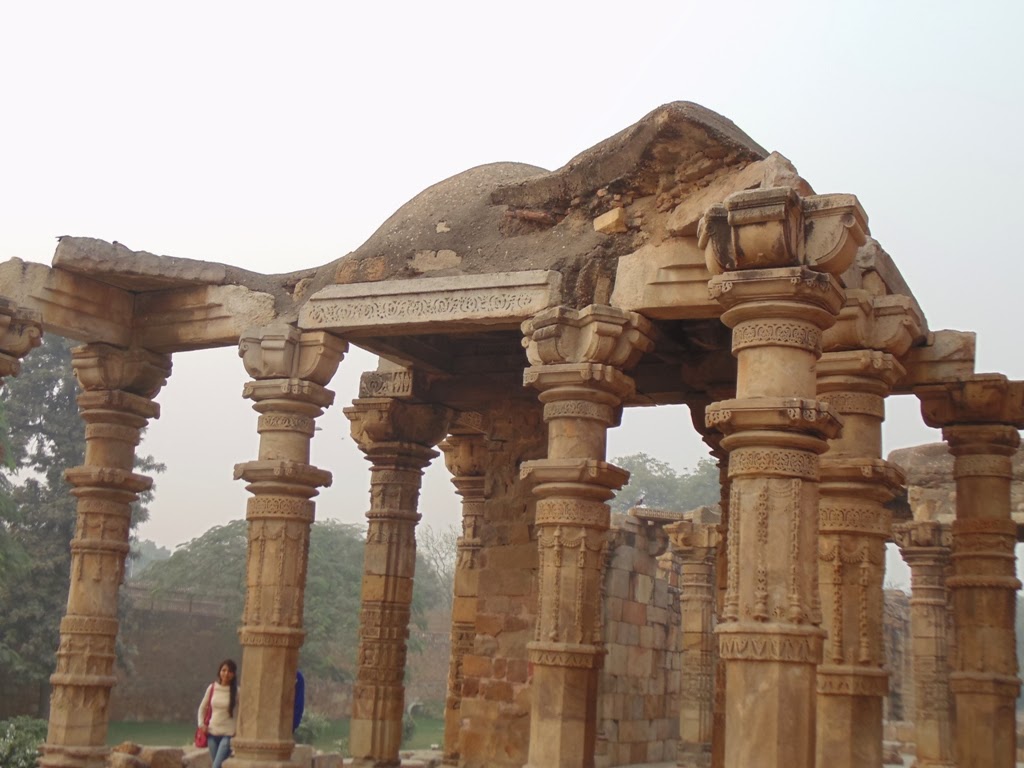
Recently team DesignGreenIndia was at a UNESCO world heritage site – Qutub complex, New Delhi. Qutub complex is worldly famous for housing Qutub Minar, a brick minaret built in 1192 AD during mughal era in India. Qutub Minar was built by Qutb-ud-din-Aibak to mark victory of Mohammed Ghori over Rajput king Prithviraj Chauhan. 72.5 m tall Qutub Minar is counted amongst world’s tallest minarets. 

Qutub Minar seen in background of a plant at Qutub Complex
Other structures at Qutub complex include tombs, madarsas (educational institutes), Jain temple ruins and a mughal garden.
Ruins of Jain temple


An Iron pillar which hasn't rusted for last 1600 years.

Mughal garden at Qutub complex is easily distinguished due to its trademark Persian style design. Mughals’ idea of garden is based on description of heaven in Quran which is ultimate place of peace and pleasure filled with birds, fruit trees, fragrant flowers, water and shade. Four quadrants, canals, fountain and pool are typical features of a mughal or mogul garden. Taj Mahal, Mehatab Bagh, Humayun’s tomb are some famous mughal gardens in India. 


However mughal garden at Qutub complex is not much big and celebrated but it is noteworthy as Qutub complex marks the arrival of Mughal architecture in India.

Have a look on Ranthambhore National Park, India.

Saturday, January 4, 2014

Best tips for growing Cilantro / Coriander / Dhania at home


Coriander/ Cilantro(Coriandrum sativum) is a popular culinary herb. Known as ‘Dhania’ (India) , Chinese parsley , Cilantro can be grown in small pots or containers with ease. Related to umbelaece family, cilantro grows, flowers and fruits within a short period of time. Seeds formed on maturation can be stored and used for next cycle of crop. It is very important to harvest the cilantro leaves on right time otherwise it would become tasteless. Try following tips for success.

Propagation
Cilantro /Coriander seedsCilantro is propagated from seeds. You can get seeds easily from market or order them online. Each cilantro fruit contains 2 seeds so you can separate them and sow as two seeds. Sow seeds 3-4 inches apart and 1/2 inch deep in to the soil. This way chance of germination also increases. It will take around 14-15 days to seeds sprout so be patient. Maintain at least 6-8 inches space between two seeds otherwise it will be overcrowded and invite pests and diseases. 

Container
Tray used as contianer for sowing cilantro seedsFirst leaf visible on cilantroPrefer a tray as a container because it gives you more sowing area compare to regular round pot or container. Planting tray should have adequate number of drainage holes to ensure smooth passage of water out of it otherwise chances of root rot increase. Put pieces of bricks or small stones on drainage holes to help with drainage.

Soil
Cilantro grows in any type of well drained soil. Loamy soil is ideal for cilantro. Add a layer of garden compost to enrich soil in nutrients.

Sun/Temperature
Place your container in a bright, direct sunlight location. Afternoon shade is also beneficial. Cilantro is a cool season crop which grows well in cool temperature. In summer or high temperature it tends to bolt means it will flower and fruit prematurely without any significant growth on foliage (leaves) which are harvested.

Watering
Take extra care while watering cilantro seedlings as they drown when water is poured directly on to the soil. Use sprayer to water the young seedlings.  Keep soil moist but do not over water it. 

Fertilizer
Feed cilantro with nitrogen based liquid fertilizer as it will help in increasing foliage on the plant. 

Harvesting
Cut off leaves and stems when the plant is at least 6 inches tall. But do not cut more than one third leaves at a time as it can make the plant weak. A cilantro plant can be harvested 3-4 times. If you want to harvest seeds then let the plant flower and fruit. Its fruit is yellow to brown in color and contains 2 seeds. These seeds falls on to the soil and can germinate on their own. So it depends on you whether you harvest seeds or let them germinate for next cycle of crop. 

Read tips of growing Holy basil at home.

Tuesday, December 24, 2013

Best Tips for Growing Zinnia at Home


Zinnia is one of easily grown annual known for its beautiful and colored flowers. Zinnia’s blooms are daisy like flower heads. The plant is grown directly from seeds and grows up to 4 feet.  Follow the below tips for growing Zinnia successfully at home.

Propagation
Zinnia's colorful bloomZinnia is propagated from seeds. Sow the seeds anytime in late April to May in warm environment. Spread soil over the seeds such that it covers the seeds partially as Zinnia seeds need light to germinate. Moist the soil and cover the pot / container with plastic bag to maintain humidity level around seeds. Seeds should sprout within a week. 

Container
Use medium sized container with adequate number of drainage holes as Zinnia doesn’t like to stand in water. Put rocks or brick pieces on drainage holes to ensure smoother water drainage out of container.

Soil
The best thing about Zinnia is that it can be grown into any type of soil. Soil can be sandy, loamy anything. But it should be well drained. Add leaves mold, compost to the soil for better results.

Sun/ Temperature
Zinnia loves sun. They thrives in full direct sun with some afternoon shade.

Watering
Keep the soil always moist. It is always good to water plant in morning as it allows the sun to dry the soil and leaves preventing any infection or disease.

Fertilizer
Use normal purpose liquid fertilizer diluted to half strength or granular slow releasing fertilizer.

Caring
Deadheading (clipping dead flowers ) is recommended to encourage blooming. If taller varieties start to bend then use a stake to give the plant support.
Zinnia doesn’t have any major insect problem, however it is susceptible to mildew causing foliage to discolor. It happens due to wet and high humid condition so avoid over watering the plant.
Also check for Botrytis blight, a gray mold which attacks flower bud and leaves. Removing those affected parts is only measure for controlling this fungus. A good air circulation also helps controlling it. 

Saturday, December 21, 2013

A visit to world known Ranthambore National Park, India

Team ‘Design Green India’ recently visited a famous Indian national park – Ranthambore National Park and was amazed with the flora out there.  The flora was consisted of around 300 species dominated by deciduous trees. The national park roughly covers 500 sq km and has a famous tiger sanctuary, a fort (considered one of the strongest forts in India) and a Ganesh Temple. Ganesh temple area is largely populated by Hanuman langurs. Tigers are main attraction of the sanctuary. They can be seen roaming in open as they are not that much feared of human presence around them.

park contains many lakes in middle of forest

According to information provided on park’s official website (http://www.ranthamborenationalpark.com/flora.html ), flora is mainly consists of Magnifera indica (Aam), Tamarandus indica (Imli) , Accasia nilotica (Babul), Ficus benghalensis (Bargad), Zizyphus mauritania (Ber), Accacia catetchu (Khair), Phoenix sylvestris (Khajur), Azadirachta indica (Neem) etc. 

Phoenix sylvestris trees
Cundil shrub

a deciduous tree
Henna tree
a wild vegetation
a hanuman langur visible in background

A wild spiny vegetation
a small tree growing on Phoenix sylvestris ( Khajur) tree

 
A red colored lake was seen in the national park (the red color was due to red algae most probably). 
a red colored lake

A garden is maintained here by Archaeological Survey of India in fort area. It is nicely bordered by purple and orange bougainvilleas. 

garden in fort area
sign board of ASI
Bougainvillea

Old banyan trees can be saw here easily. A gigantic banyan tree considered as India’s second largest is situated near padam Talao (a lake) in the national park.

Banyan trees near Ranthambore tiger sanctuary entrance
In short it is a must visit place, we would recommend a trip to Ranthambore to all nature lovers. 

Check out more pictures.

More : A Visit to UNESCO world heritage site - Qutub Minar.

Friday, December 20, 2013

Best ways of treating and controlling powdery mildew


Powdery mildew

As name suggests it is a fungus (mildew) caused plant disease in which plant parts like leaves, stems, flowers and buds are covered with a powder like substance. The powdery substance is nothing but numerous spores of fungus produced in high humidity and moderate temperature environment.

Powdery mildew is common problem of plants like rose, zinnia, and lilacs. It also affects some vegetables – sweet peas, gourds, melon, and onion and grapes plant.


Symptoms

Powedery mildew affected sweet pea leavePowdery mildew attacks lower plant parts (bottom leaves) first which are just above the ground, then it move upwards affecting upper leaves, stem, buds and flowers. White spots start developing on affected leaves which keep enlarging with time. Leaves become colorless and fall off ultimately.

However, plant doesn’t die on attack of powdery mildew but it weakens and produces less number of blooms and fruits. In ornamental plants, it could affect look of the plant by destroying foliage. 


Reasons of infection

On favorable conditions of high humidity and moderate temperature fungus reproduces quickly and generates large number of spores.  Spores spread with wind and affect nearby plants. 
Fungi affecting leaves starting at bottom


Control and Treatment

Powdery mildew can’t be cured but it can be prevented and treated in following ways.


- Take out infected leaves or plant in case of small level infection and put them separately in a plastic bag. It would help in stopping infection to nearby growing plants and vegetables. Compost bag material if you want.


- Make sure that plants are having proper aeration and getting enough direct sun light as it inhibits spore germination.


- Spray milk diluted with water (1: 10) on susceptible plants. Repeat the application to eliminate the disease.

Mix 1 tablespoon baking soda with normal water and spray on affected parts. Add few drops of liquid soap in it.


- Garlic extract is a good and cost effective way of controlling powdery mildew. It can be made by blending two garlic in 1 liter water with few drops of liquid soaps. Strain the mixture through a cloth to remove the solid part and spray the liquid on the plant.  


- Spray plant with neem oil made by seeds. Neem oil has fungicidal properties. It disrupts fungus metabolism, forms a barrier between the plant and the fungus and inhibit spore germination. On application it is absorbed by the leaf and circulated around to maximize area of coverage. Neem oil mixed in water, absorbed by the roots and circulated all over the plant.


- Use sulfur sprays available in market to control powdery mildew as sulfur creates low pH environment which is detrimental for the fungus.

Read ways of controlling mealy bugs and aphid attack on the plants.